Who were Matthew, Mark, Luke, & John? (pt. 2): Mark
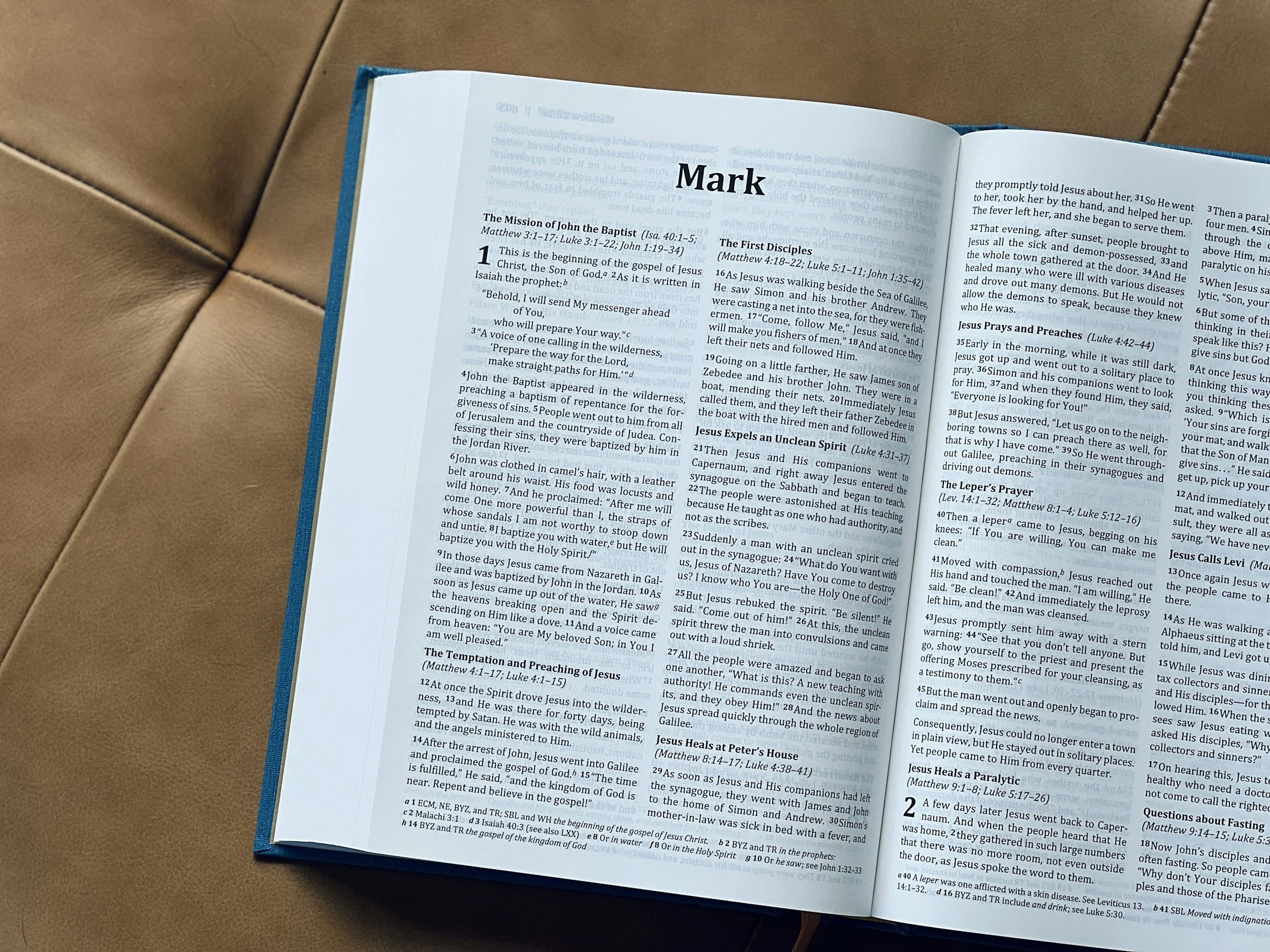
Photo by Tim Wildsmith
This is the second of a four-part series on the four Gospel authors. Yesterday I looked at Matthew. Today I look at Mark. Tomorrow I will look at Luke.
The Gospels are the first four books of the New Testament of the Bible, and they tell the story of Jesus' life and teachings. The names of the Gospels are Matthew, Mark, Luke, and John. Mark's Gospel is the shortest of the four.
So, who was Mark?
Unlike Matthew, Mark was not one of the twelve disciples who spent intimate time with Jesus. However, because he was likely from Jerusalem, he may have witnessed some of the events surrounding Jesus' final days. And he may have been a protege of other followers of Jesus. Tradition has it that Peter, one of Jesus' twelve closest disciples, was Mark's mentor. Also, Mark may have spent much time with another important New Testament figure named Paul.
We learn in the book of Acts, which is the story of the earliest church, that a young man named John Mark spent time with Paul. Mark may be the same person referred to in Acts as John Mark. As I explained yesterday, others like Matthew had multiple names (Matthew, Levi), including Peter (Simon, Cephas, Peter). So it is quite possible that John Mark, who spent time with Paul, is the same Mark who wrote the Gospel.
Paul is important for starting churches throughout the Mediterranean region and for writing nearly half of the New Testament of the Bible. This is a critical piece of the story because Paul actually gets into a disagreement with his companion Barnabas over Mark, who appears to have withdrawn from a journey they were on earlier. Paul didn't want to take Mark on a new journey for this reason, but Barnabas did, which led to a disagreement between them. This is presumably because Mark was Barnabas's cousin, and Barnabas felt a sense of familial loyalty toward him.
We don't hear how this conflict was resolved, but Paul refers to Barnabas in multiple of his letters, including 1 Corinthians and Colossians, which were most likely written long after this disagreement. Because these references are positive, they may have been reconciled. In Colossians, 2 Timothy, and Philemon, Paul also refers to Mark. If this is the same Mark, it seems Paul's views of Mark were positive in the end as well. In fact, in 2 Timothy, he tells Timothy, "Get Mark and bring him with you, for he is very useful to me for ministry," and in Philemon, he refers to Mark as one of his fellow workers.
Peter also wrote a couple of letters that are in the New Testament, and at the end of his letter called 1 Peter, he says, "She who is at Babylon, who is likewise chosen, sends you greetings, and so does Mark, my son." If this is a reference to the same Mark, then Peter indeed seems to have had a mentoring relationship with him. One traditional view is that much of what is in Mark's Gospel comes to him through Peter, an eyewitness.
In Acts, we also learn that Peter stayed at the home of John Mark's mother, Mary, in Jerusalem. This is another data point that connects Mark to Peter. It also suggests that Mark was from Jerusalem. It is therefore possible that Mark also witnessed some of the events from the life of Jesus that he recounts in his Gospel, potentially making him an eyewitness. However, early Christian tradition emphasizes that his Gospel is primarily based on what he received from Peter.
Beyond that, much of what we know about Mark is based on historical traditions that may or may not be true. For example, one humorous piece of speculative tradition identifies Mark with an unnamed young man he writes about in his Gospel who runs away naked just before the crucifixion of Jesus. You can read it here.
We can undoubtedly say the following about Mark's Gospel, though: It is the shortest of the four. It is characterized by a sense of urgency, often using the word "immediately." And unlike Matthew and Luke, it does not include material on the birth and childhood of Jesus. However, there is significant overlap in its content with the Gospels of Matthew and Luke.
Also, the conflict between Paul and Barnabas over Mark is actually really hopeful information. When Mark was younger, Paul didn't trust him because he felt Mark had abandoned him on an earlier journey. But something clearly happened that allowed Mark not only to regain Paul’s trust but also to consider him a colleague and peer, and Mark went on to write one of the most important written artifacts in human history. Mark's story then shows the possibility of growing in maturity as a follower of Jesus and of being reconciled with others in the community.
Finally, if it is true that much of what Mark wrote comes down to him through Peter, then we see so much humility on Peter's part. This is because much of the material about Peter in Mark's Gospel shows the mistakes Peter made, including his denials of Jesus at the crucifixion. Peter seems to have made no effort to have Mark make him look better and save face. He is instead honest about his past.
If you appreciate this post/series and think someone else might find it helpful, please share it. You can also subscribe to this blog by clicking the appropriate button either above or below this post. And I hope you will read tomorrow's post to learn more about Luke.